

 Contact us
 Visit CPRE.org
 Donate
Brighton & Hove City Council’s Local Transport Plan doesn’t go far enough.
CPRE Sussex Director’s column written for The Argus, 20 September 2025
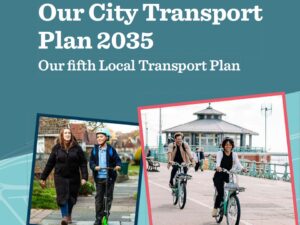
Throughout the summer Brighton and Hove City Council has been consulting on its new Local Transport Plan.
The council says the plan will help make our city safer, healthier, more sustainable and more active.
Why does any of this matter to us at CPRE Sussex, as the ‘countryside charity’?
Well, for one thing we care about how easily people in Sussex’s towns and cities can access the beauty and fresh air of the Downs on their doorstep.
For another, how people travel to Brighton & Hove has a big impact on the countryside – more cars often lead to more calls for roadbuilding.
Climate change is the single biggest threat to the future of farming, wildlife and rural communities, and urban transport is a big contributor to polluting carbon emissions.
So, what happens in Brighton & Hove matters to Sussex and beyond.
Finally, our focus is not only on the rural, but on precious urban green spaces too – bringing the countryside into the city, including through our Plant Your Postcode tree scheme.
At CPRE Sussex we welcome the council’s ambition to encourage active travel and public transport – and to cut carbon emissions.
However, we are concerned that the actions proposed are insufficient to deliver the plan’s bold ambitions.
In its current format, the City Transport Plan 2035 contains almost no vision about how we can create better places if we take cars out of more of the city centre.
There is also a worrying lack of attention paid to the impact on the urban fringe and our precious countryside.
A need for bolder policies
If we are to deliver on climate, air quality and congestion, we need to see private car use falling in the city.
Nearly 2 in 5 households across Brighton & Hove have no car or van.
That is a lot of people whose health and wellbeing gets pushed to the side in how we use our streets.
We need to start focusing on their needs, while also ensuring protections are in place for people who need to use cars and decarbonising the car use that remains.
Shifting journey use to active travel and public transport will likely need bolder policies around Low Emission Zones and a reduction in parking places in the urban centre.
Charging measures are likely to be needed to generate the funding for transport alternatives.
Concerns over Park and Ride
An area of particular concern for CPRE Sussex in the current plan is the introduction of Park and Ride facilities as part of “strategic mobility hubs” on the outskirts of the city.
Transport for the South East (TfSE) has said strategic mobility hubs are needed at Falmer, Shoreham-By-Sea and the A23/A27 junction.
Bus Service Improvement Plan (BSIP) funding is being used to help make the business case for Park and Ride and the creation of a purpose-built facility.
In the meantime, BHCC hopes to use existing car parks outside the city centre, alongside existing bus services, to provide some Park and Ride capacity.
However, we remain unconvinced that Park and Ride will deliver on critical transport aims.
A recent academic evidence review found Park and Ride increases the distance travelled in cars and has a negative impact on ‘modal split’. This means people use their cars more, rather than less.
We would also strongly object to the creation of Park and Ride sites that have a negative impact on the setting of the South Downs National Park, the urban fringe or green spaces.
CPRE Sussex supports local neighbourhood hubs in principle.
But only if they are combined with other transport policies that encourage modal shift towards active travel and public transport and reduce overall car use.
Using kerbside spaces
BHCC needs to free itself from its obsession with using every centimetre of kerb space as a car park – and as a cash generator via parking fees.
Instead, it needs to reallocate “road” space to other uses including walking, wheeling, pocket parks and green infrastructure.
For example, Lambeth council has a bold Kerbside Strategy which sets out plans to use a quarter of all roadside space into places for people, not just cars.
This includes planting trees in the kerbside rather than the pavement – creating clearer, more accessible pavements for everyone.
Linking to the countryside
An effective transport plan is not just about getting people into the city efficiently.
It is also about connecting them with the magnificent landscapes and habitats which surround Brighton & Hove.
Strong public transport links are vital to ensure people without cars can get out and explore the countryside.
The council’s plan acknowledges that bus users want more frequent services to underserved parts of the city, but also the South Downs National Park.
The Breeze Up bus services to Devil’s Dyke, Ditchling Beacon and Stanmer Park and the coastal services to Seven Sisters and beyond are essential. As are the routes that connect the city to Henfield, Horsham, Lewes, the Low Weald and more.
The trains, cycling and walking routes that head out through our urban fringes also offer critical countryside access to a host of people who do not drive.
We are so incredibly lucky to have the national park right on our doorstep – but we need to make sure that everyone can access it
Time for a new approach
Of course, Sussex’s transport problems extend far beyond the boundaries of Brighton & Hove.
Across the county, there is still far too much focus on roads and not enough on sustainable transport and getting people more active.
The new Mayor of Sussex, set to be elected next year, is a huge opportunity for bigger, more joined up thinking – and a move away from TfSE’s continuing obsession with roads.
While TfSE’s recent consultation said all the right things about sustainability, its investment plans still appear to focus on shaving a couple of minutes off car commutes by roadbuilding, rather than ensuring reliable train and bus connections to towns and villages.
The new Sussex mayor could turn that around and embrace a bold new approach to transport across the county.
A redrafted plan
In our response to the plan consultation, we urged the council to be bolder to deliver a greener, more accessible, better city for all.
We hope the redrafted plan, set to be taken to cabinet this winter, will include a true vision for transport across the city.
Want to help CPRE Sussex shape a greener future for Brighton & Hove?
Find out more about our work and how you can get involved at cpresussex.org.uk/get-involved/