Contact us
 Visit CPRE.org
 Donate
Find out about Elm Disease
Every year in Brighton we are losing more trees to Elm Disease. Find out more about Elm Disease, the vaccine and how we are helping Brighton Elms here:
Elm Disease FAQs
What is Elm Disease?
Elm Disease (DED) is a fungal disease that is spread by beetles and causes significant harm to Elm trees (Ulmus genus). Formerly known as Dutch Elm Disease, it was identified in the Netherlands in the 1920s and has been affecting Elm trees across the world for the past century.
How did it get here?
It is widely understood that like many other diseases that impact our trees, Elm Disease arrived to the UK because of the importing of foreign wood into the UK.
The latest and most aggressive mutation of Elm disease we are witnessing at the moment is due to Elm logs being brought into Brighton for burning in the wood burners of private homes.
How does the disease spread and what does it do to Elm trees?
Elm Disease is spread by beetles. There are eleven known species of beetle that carry it, including the large elm bark beetle.
Elm bark beetles breed in the bark of diseased Elm trees then move to healthy Elm trees where they feed. As they feed, the spores of Elm disease spread into the tree’s xylem (its vessel for moving water and nutrients upwards) which stops the tree from being able to feed itself and eventually causes it to die.
The loss of an Elm tree happens quickly – first the leaves on its upper branches start withering and within weeks the whole tree is leafless and dead.
Diseased and dead branches can fall without warning and are a risk to public safety – hence the need for diseased trees to be felled.
How is Elm Disease affecting our Brighton treescape?
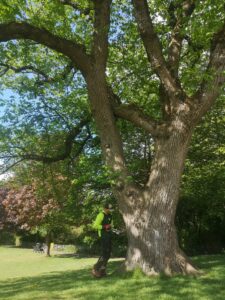
With Elms making up a third of all trees in Brighton & Hove, Elm disease is having a devastating impact on our city! We are losing more and more Elms every year – in 2025 we lost more than sixty Elm trees due to disease and because of this summer’s heat (and therefore the heightened activity of the beetles) we are anticipating many more losses this year.
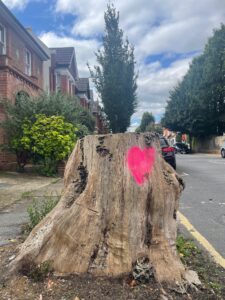
Sadly, stumps are becoming a common sight on Brighton streets and causing residents much distress.
What is the Elm vaccination?
The Elm vaccination is called Dutch Trig (Verticillium fungus) – a vaccine which has been recently developed and manufactured in the Netherlands.
Is the Elm vaccine used in Brighton?
Yes! 2026 is the fourth year that the vaccine has been used on Brighton trees, with 1800 Elm trees being vaccinated by Brighton & Hove City Council this year.
How does the vaccine work?
The vaccine protects Elm trees from contracting Elm disease. It can only be used on healthy Elm trees and the vaccine must be administered annually to ensure the ongoing prevention of disease.
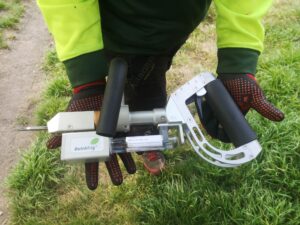
An injector is used to deliver the vaccine into the trunk of the tree. It is a quick and straightforward procedure and does not harm the tree.
The vaccine must be delivered in spring (before the beetles become active) to minimise the risk of the Elm tree contracting the disease.
Does the council vaccinate every Elm tree in Brighton?
Whilst the council have increased the number of Elms vaccinated each year they simply do not have the funding to vaccinate every healthy Elm tree on Brighton streets.
At CPRE Sussex we have started working with Brighton resident groups wanting to vaccinate their own street trees and for 2027 we are encouraging more residents to vaccinate their Elms.
I’m interested in vaccinating a tree on my street, how much does the vaccine cost?
Depending on the age of the tree and the number of trees being vaccinated the price of vaccinating (per tree) can vary. In 2026, the cost ranged from £35 to £150 per tree.
How can I find out if I have Elm trees in my area?
While there are many species of Elm they all have one physical characteristic in common – an uneven bottomed leaf! If you look at where the leaf base joins the petiole (stalk) on an Elm leaf one side will always join the stalk lower than the other side. That’s the easiest way to identify an Elm!

Identification guides and apps such as Plant Net may also be helpful to use, and you can always email us if you’re unsure.
How can I help support trees in my area?
- If you have Elm trees on your street that you are interested in vaccinating, please email us at info@cpresussex.org.uk!
- Support our Plant Your Postcode projects! Link
- Don’t buy or store Elm logs in or around your property!