Contact us
 Visit CPRE.org
 Donate
Ash Dieback disease in our woodlands
We could lose 40,000 of our local trees to Ash Dieback disease. But is there hope to be found? Our resident tree expert and Plant Your Postcode manager Jen Eneke explains.
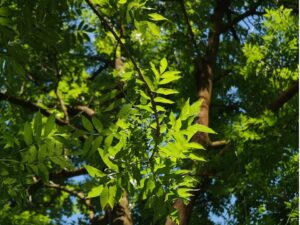
What is Ash Dieback?
Ash Dieback disease (ADD) is a fungal disease. Originating in Asia, it has been identified and known of in Europe for about thirty years and was identified in the UK in 2012.
How did it get here?
Although it is possible that it may have arrived to the UK by wind (the spores can travel for tens of miles) it is widely thought to have been caused by the importing of Ash plants from infected parts of Europe.
What effect does it have on our native Ash trees?
The spores of the Hymenoscyphus fraxineus fungus (moved by wind) land on Ash leaves and then penetrate into the tree, infecting its vital water transport systems and eventually blocking them, causing the tree to die. Symptoms of ADD include the blackening of Ash leaves and lesions on the tree’s bark.
Once the tree has ADD it has little chance of survival, and unlike Elm Disease there is no inoculation we can administer to protect healthy Ash trees.
How is ADD affecting our woodlands?
In the UK, ADD has had the most impact in the south-east of England and with Ash comprising one in five of our Brighton woodland trees we are seeing the impact of this disease first-hand. It is estimated that we will lose 40,000 of our local trees to ADD. Nationally, it is estimated we will lose 80% of our Ash trees.
Ash Dieback is impossible to contain and spreads easily from tree to tree. Sadly the removal of dead and dying trees is essential to keeping the public safe from the possibility of falling tree material. This had led to major felling in our woodlands, which will continue this winter.
What hope is there?
Looking forward, recent research has suggested that a new generation of Ash trees may be resistant to the Hymenoscyphus fraxineus fungus. This gives us hope for the future of Ash trees, but in the meantime we need to appreciate the impact of ADD and understand its impact on our woodlands. We are still in the early stages of this disease.
Whilst tree-felling can cause tree-lovers like me distress, it is worth noting that it also brings opportunity for increased biodiversity. For example, deadwood is an amazing habitat that is often overlooked – or considered messy! Deadwood (in the form of stumps, logs, snags, dead hedges, log piles) is part of the life cycle of 40% of our woodland creatures and should ideally make up to 30-40% of tree material within a woodland. One way that deadwood supports multiple species is by enabling saprophic fungi to feed on the polyaccharides within the wood which leaves soft, nutrient-rich debris that invertebrates can then consume.
Where some of our local woodlands have many similar-aged trees felling offers opportunities for replanting and supporting younger trees to flourish, as well as increasing species diversity. An ideal woodland would have a mixture of tree species, of different ages and different heights. It would support life at every layer – from the ground all the way up to the canopy.
Felling trees also has the benefit of changing the light levels within a woodland and allowing more sunlight to reach the woodland floor, thus allowing more opportunity for ground flora to flourish.